A JOURNEY IN PHOTOGRAPHS
Golden Altay: An October Morning in Hemu and Kanas
Yellow trees, dark wooden roofs and blue-green water in a morning photo series from northern Xinjiang.
Hemu / Valley views / Kanas / The water’s edge
OPENING FRAME
A tree above
the valley.
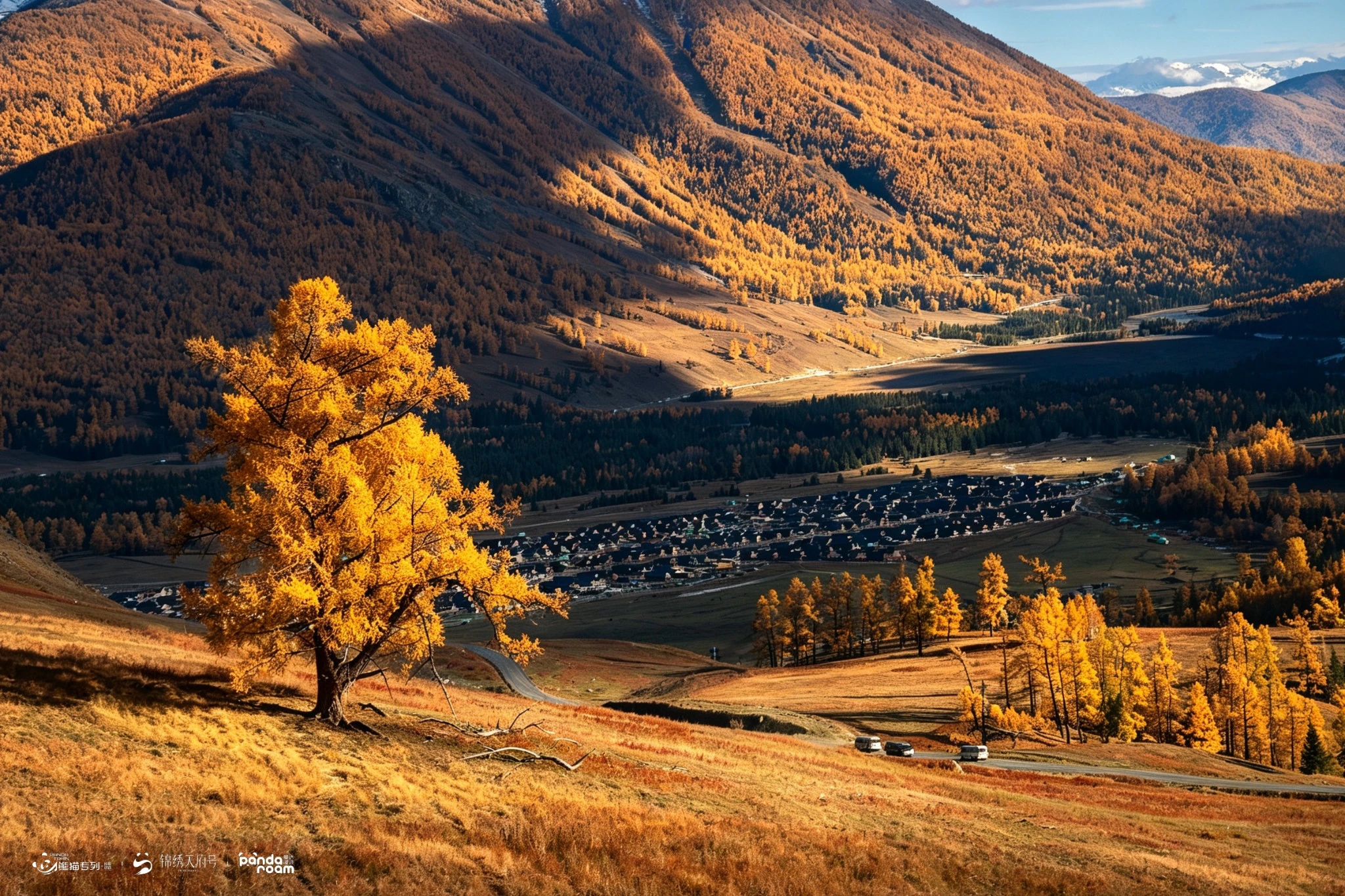
A yellow tree stands on an open slope above a village. Behind it, a road curves across the valley. The far hillside catches the sun, while the buildings below sit in shade. It is an autumn scene with a clear centre, but the photograph rewards a look beyond that bright tree. The small roofs and the road explain just how much space surrounds it.
The Panda Roam photography team supplied these photographs from Hemu and Kanas as a morning series dated 6 October 2026. Gold runs through the series, but the light keeps changing. Clouds press down over wooden cabins. Across the water, whole slopes catch the sun. There is more to this autumn morning than its brightest colour.
01 / HEMU
Hemu begins with a road
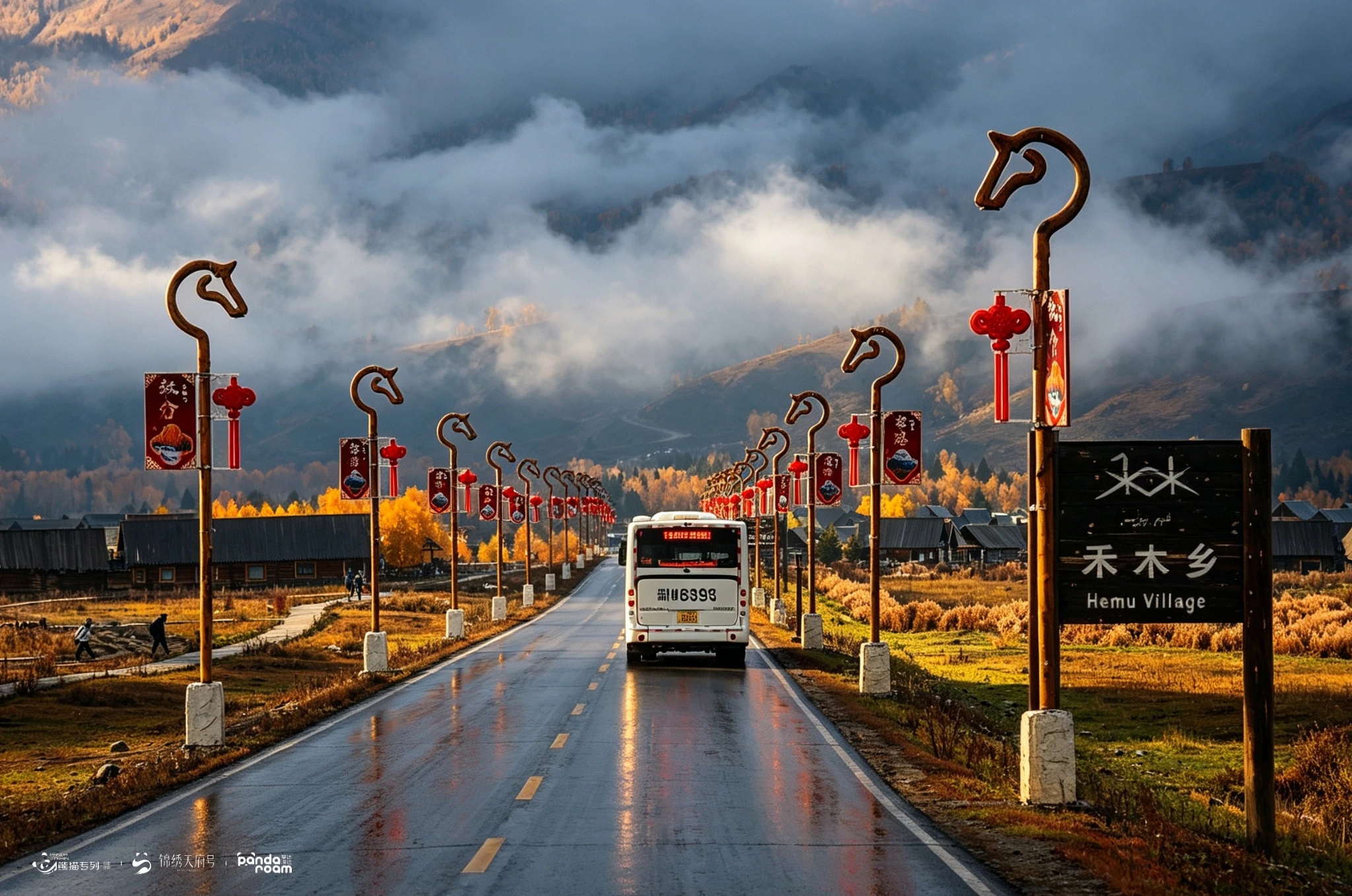
The clearest place name in the series appears on a roadside sign: Hemu Village. A bus is on the road ahead. The surface reflects the sky, and decorated lamps repeat along its edges. Beyond them, autumn trees lie below heavy cloud.
The road gives the village an approach. The lamps draw the eye forward, past the bus and towards the trees. The hills are close, but the road occupies most of the foreground. Its reflected light makes a grey patch of sky feel much larger.
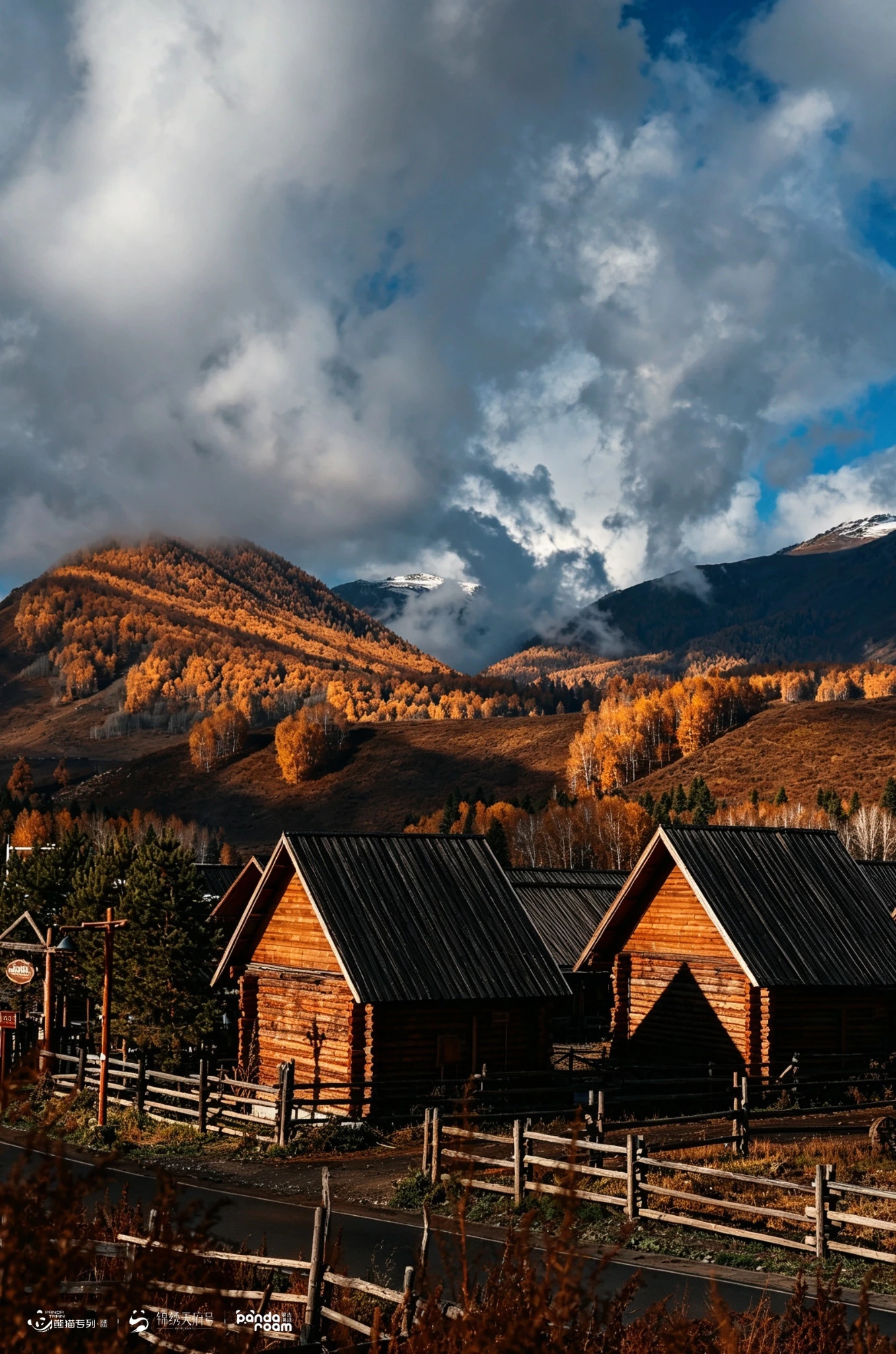
The next view brings the buildings closer. Wooden cabins sit behind a fence, with their steep roofs turned towards the camera. The clouds take up much of the photograph. Light reaches the cabin walls through breaks in the cloud. Their wood catches an orange glow, while the hill behind carries yellow trees.
Together, the two images resist an overly tidy picture of autumn. There is gold in the trees, but there is also wet tarmac, shade and a sky that does not promise to stay clear.
02 / VALLEY
The tree above the valley
In the selected valley photograph, the yellow tree sits off centre. The ground around it is open, and the valley continues well beyond its crown. Small roofs lie below the tree. Their size makes the distance across the valley easier to judge.
The open framing gives the valley room. The tree marks the foreground. The eye can follow the road, find the cluster of roofs and climb the far slope. The darker forest along the valley floor holds those separate parts together.
This is where an autumn photograph can avoid becoming only a study in yellow. The shadow has a job. So do the bare ground and the small areas of green that remain. Without them, the bright leaves would have much less to stand against.
The road is worth following with the eye. It curves past the village and disappears into a darker part of the valley. For a moment, the tree that first commanded the photograph becomes part of a much larger place.
03 / KANAS
Kanas, seen through changing water
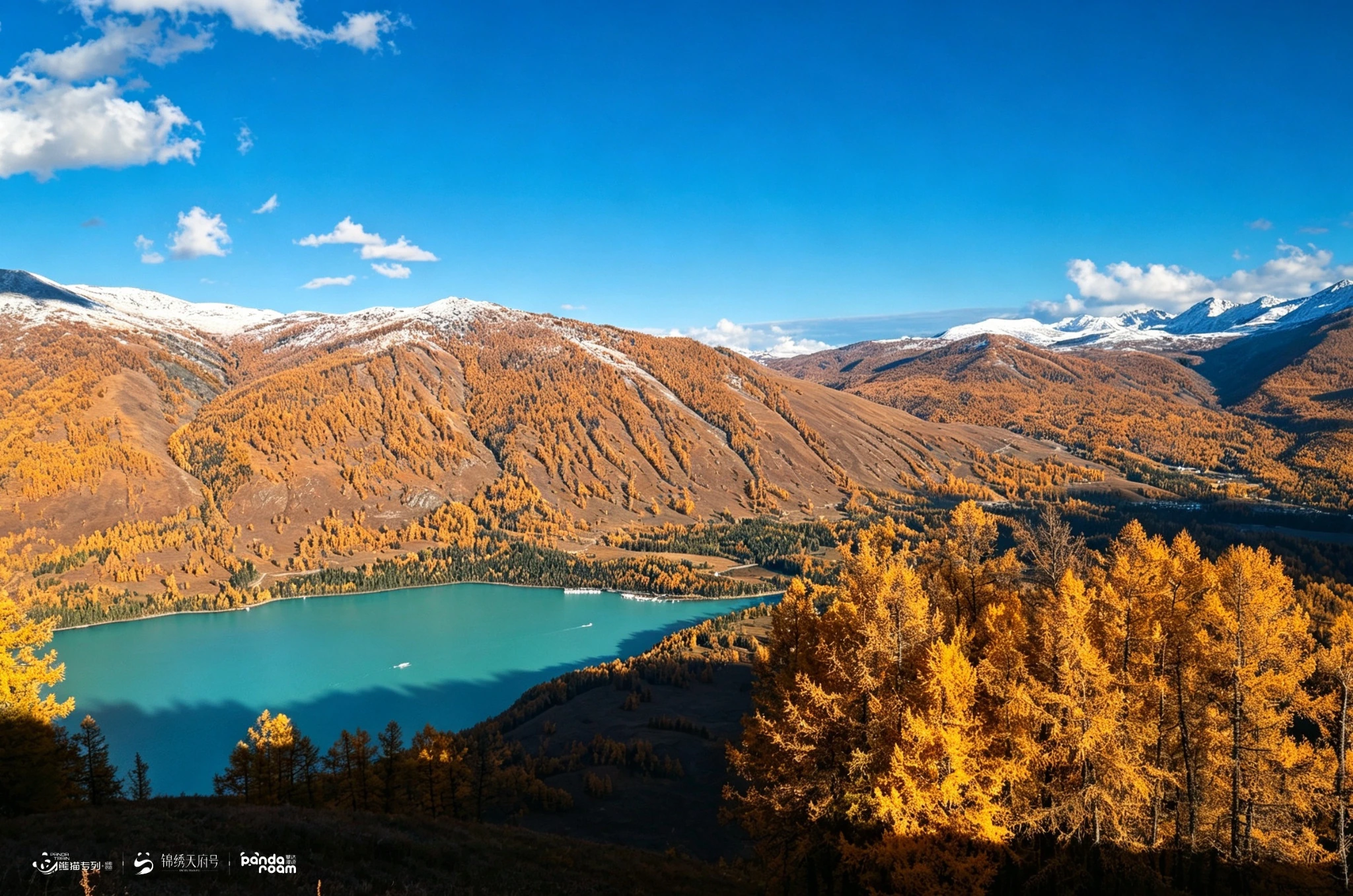
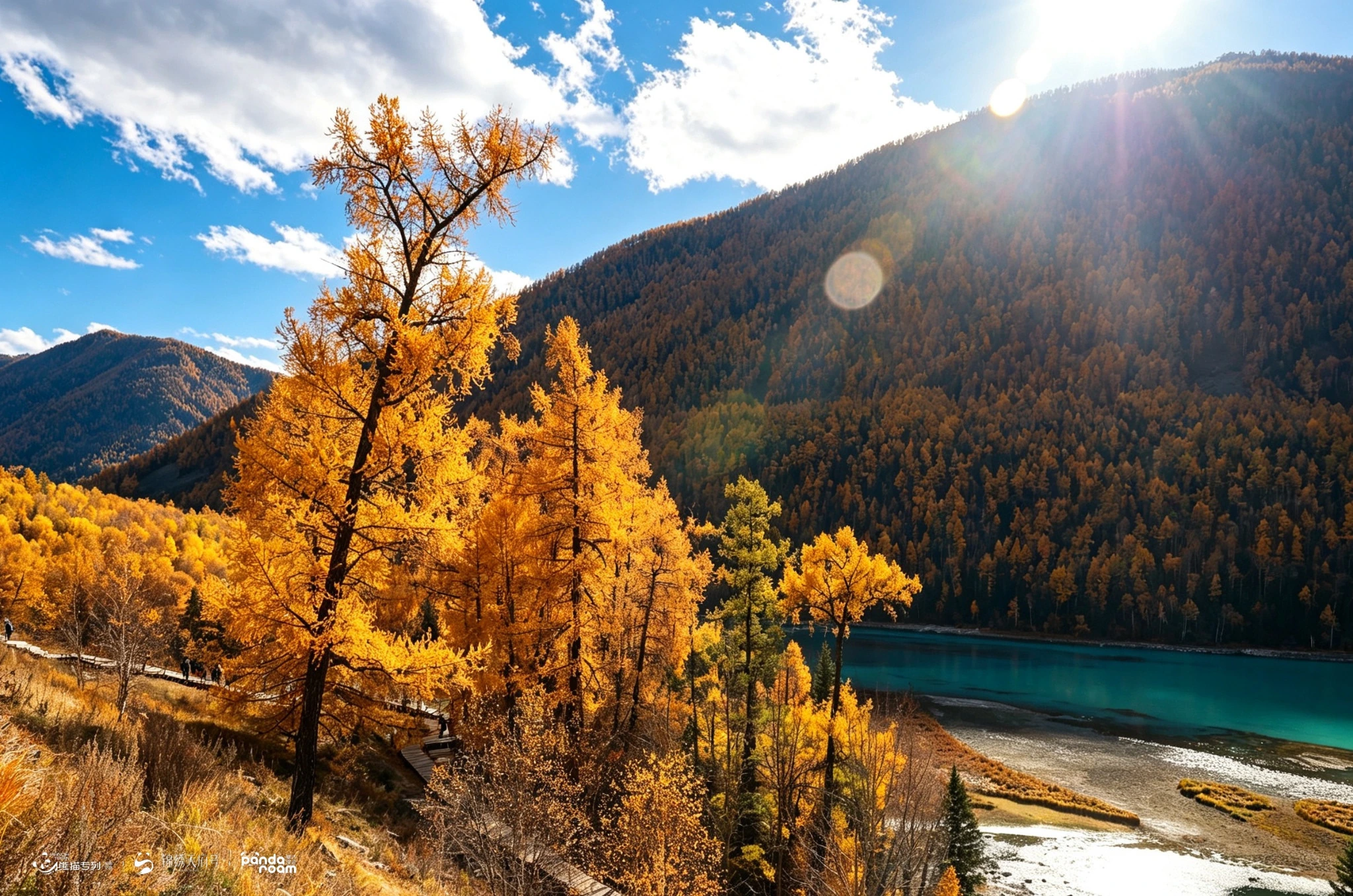
The lake views introduce a different colour. Blue-green water sits below wooded hills, with snow visible on higher ground. Near the camera, yellow trees partly cover the shore. The water opens between them in a shape that leads the eye towards the far side.
Kanas lies in the Altai Mountains of northern Xinjiang. The Xinjiang Department of Natural Resources describes the lake’s present form as the result of fault activity and glacial movement. It also notes that the water’s appearance varies with season, weather and viewing angle. A different blue on another visit would be no surprise.
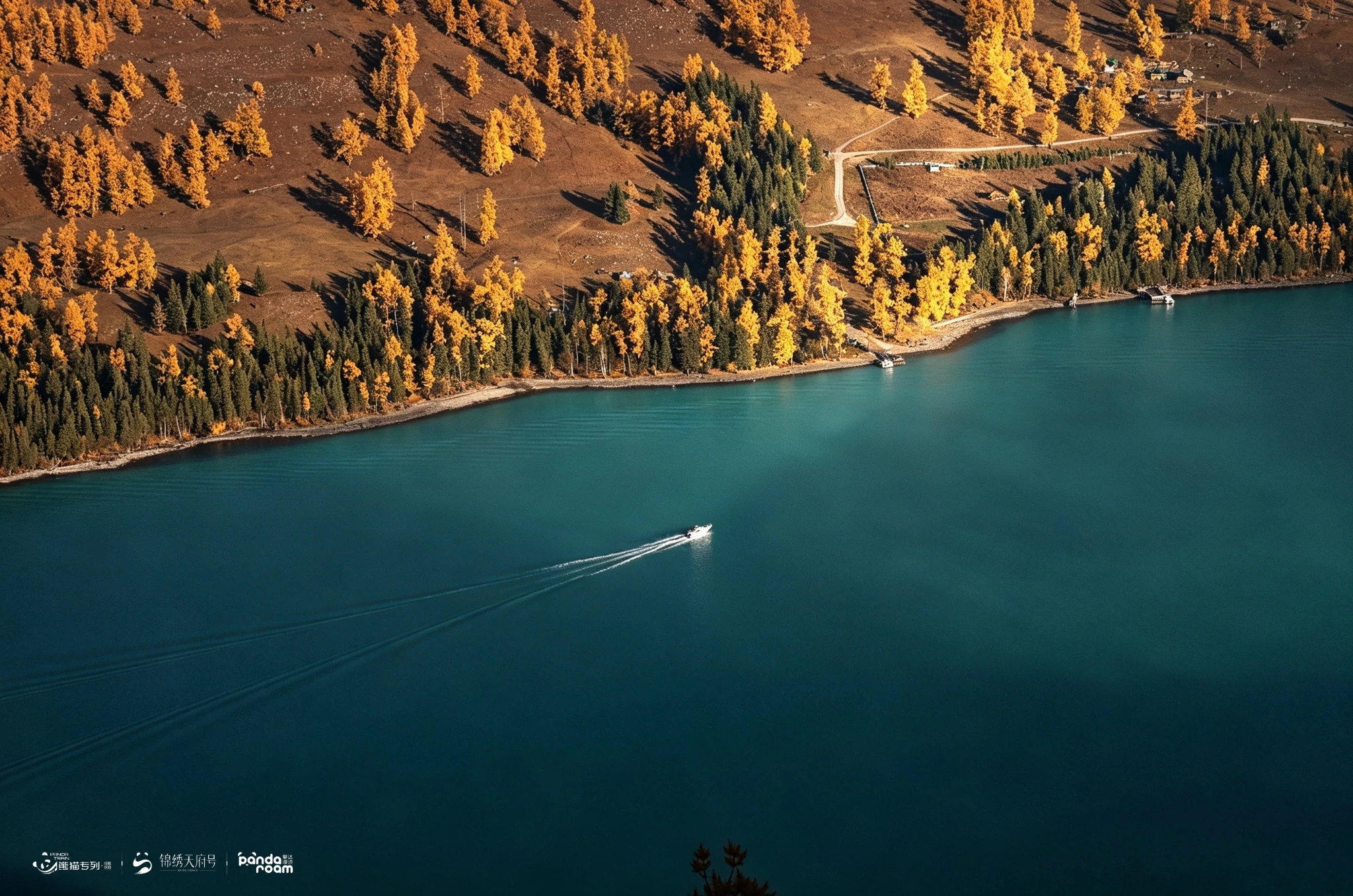
In one image, the lake looks bright and open. In another, the shore is darker and the colour deepens. A small speedboat leaves a pale trail across the surface. Its wake gives the picture a measure of movement, though the photograph offers no sound and no reliable sense of speed.
That small mark is easy to miss on a phone. Seen larger, it makes the opposite bank feel farther away. A line of trees that first looked like a border becomes a long stretch of shoreline.
04 / WATERSIDE
Down to the water’s edge
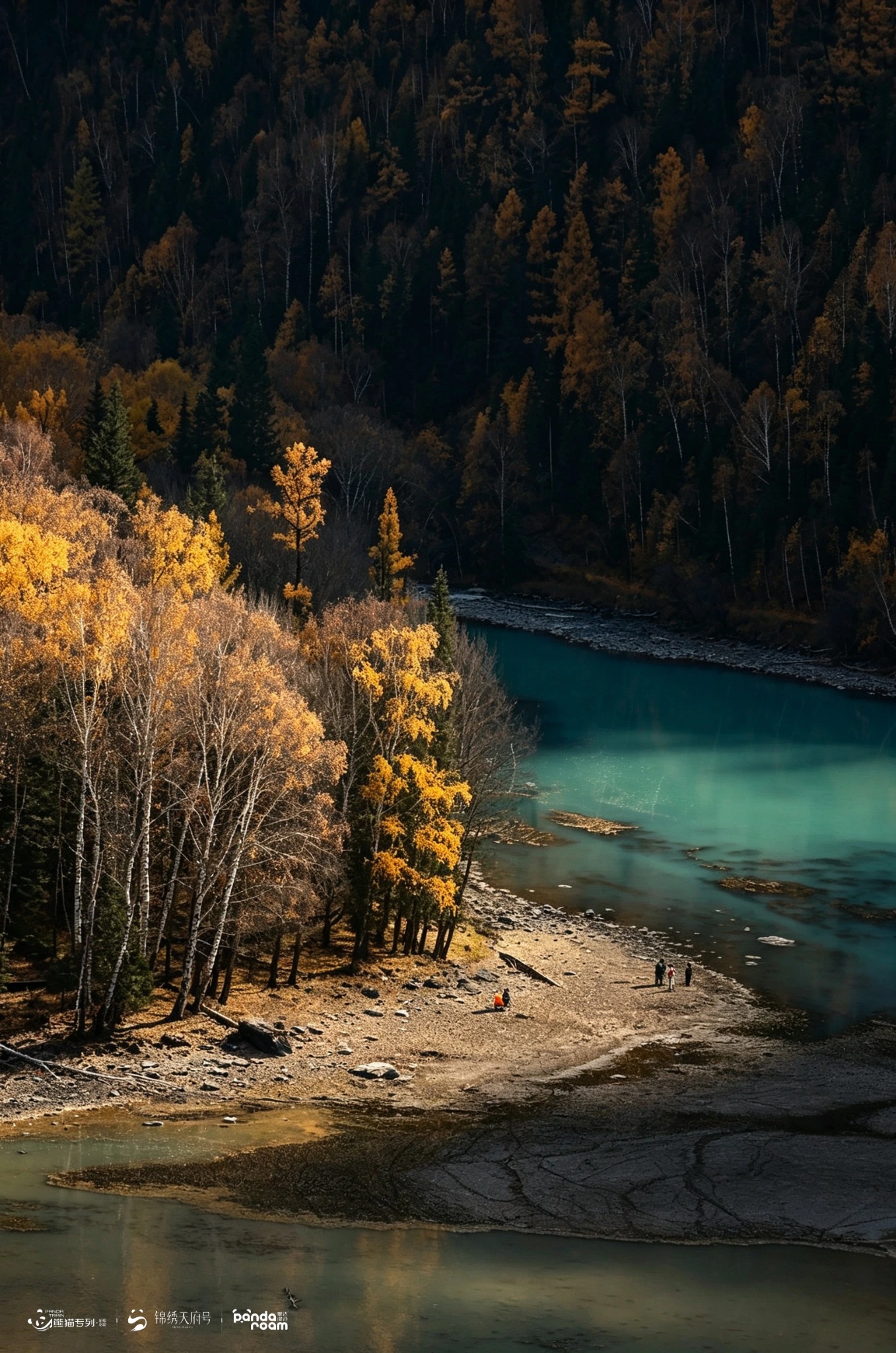
The views from higher ground are followed by closer scenes. A boardwalk runs beneath autumn trees beside blue-green water. Sunlight enters near the top of the frame and leaves bright patches among the branches. A separate vertical photograph looks down towards a river bend and a stony bank.
A few people stand near the water in that river view. They are small enough to change the sense of scale without becoming the subject. The stones, bank and trees take on a size that would be difficult to judge without them.
The bank curves between trees and water. Part of it is bright, and part lies in shade. On the opposite side, the hillside rises steeply. The narrow vertical frame brings these edges close together, leaving the river only a small space to cross the picture.
There is something satisfying about that restraint. After the broad lake views, the eye comes back to reachable things: boards underfoot, branches overhead, stones at the water’s edge. The landscape has not become smaller. The camera has simply moved closer to it.
AT THE WATER’S EDGE
Boards underfoot.
Branches overhead.
A closer view of the shore.
05 / MORNING
A morning, without a fixed promise
The series contains dark cloud and blue sky, sunlit cabins and bright hills. Those differences are part of its appeal. They also make it unsuitable as a promise of what another visitor will see at a particular hour.
For a traveller, that is a reason to keep some space in the day. A cloud can change how a hillside looks. A lower path can reveal something that a viewpoint leaves out. Hemu and Kanas deserve time for both the broad views and the smaller scenes beside the road.
For the essay, the order can be simpler. Begin on the road, look out across the valley, then come down towards the water. End with the boat’s thin wake or the people on the bank. Either one gives the large views a small detail to hold onto.
The yellow tree remains the most immediate image. After a longer look, the less obvious details stay too: light on a bus window, a fence beside a cabin, the dark line of the far shore. They give this October morning its particular shape.
FIELD NOTES
Before visiting Hemu and Kanas
Hemu is a village in Burqin County, in Xinjiang’s Altay Prefecture. The National Development and Reform Commission places it within the Kanas tourism area. This shared regional setting does not make every lake or valley photograph a view of Hemu.
Kanas is a scenic area in the Altai Mountains of northern Xinjiang. The Altai is a mountain system in northern Xinjiang, distinct from the Tianshan farther south. The regional government’s geographic outline helps place the names on a map.
| Planning point | What to check |
|---|---|
| Transport | Arrange transfers between Hemu and Kanas as separate places. This page does not describe a one-morning drive. |
| Travel date | Check current road access, visitor transport and weather. The reported photo date, 6 October 2026, is not a forecast. |
| Time outdoors | Allow time for pauses and changes. Do not plan fixed stops around the light or foliage in one photograph. |
| Local access | Follow marked paths and local instructions. Keep roads and entrances clear. Ask before close photographs of residents. |
For example, the Hemu road photograph and the lake view can appear beside one another in an album. Their order does not establish the transfer time between the two places. Check the actual journey before arranging a fixed arrival or departure.
For practical route context, continue with the complete Xinjiang travel guide.
EDITORIAL NOTES
About the article and photographs
This essay was prepared by the Jinxiu Tianfu editorial team with AI-assisted drafting, human review, supplied original photography and the official sources cited above. The editorial writer did not report from these locations.
Photography is by the Panda Roam photography team. The team identifies the set as a Hemu and Kanas morning series dated 6 October 2026. The visible Hemu sign confirms that location. Other captions follow the team’s regional account without assigning exact viewing platforms or river bends.
- File comparison found each of the seven published photographs to be unique; an exact duplicate elsewhere in the larger supplied album was not used.
- The supplied files contained no capture-time or GPS metadata, so filenames were not used as location evidence.
- Caption checks compared visible features with the team’s account and official regional sources. Unverified viewpoints remain unnamed.
The reported photo date is not a sunrise time, an itinerary sequence or evidence of a one-morning driving route. Current access, transport and weather should always be checked separately.
Page sources were reviewed on 8 October 2026. This article was first published on Jinxiu Tianfu on the same date.
How can you join a Jinxiu Tianfu journey?
Start with the current Xinjiang itineraries to compare trip lengths, stops and daily arrangements, then read the booking guide. Tell the team your intended travel year, party size, cabin preference and any dietary or mobility assistance needs, and obtain written confirmation for your chosen programme.
- Explore current Xinjiang itineraries
Compare trip lengths, routes and daily arrangements.
- Read the booking guide
Check the chosen programme, applicable terms and written confirmation.
- See cabin photographs
Understand the cabin space and consider your party's needs.
- Ask the Jinxiu Tianfu team
Share your intended year, party size, cabin preference and specific needs.
Reports and photographs record a particular journey or photographed scene. Current departures, prices, availability, staffing and service arrangements depend on the chosen programme and written confirmation.